This past summer, NYSG supported two CEI interns, both undergraduates at Stony Brook University, in gaining hands-on experience working with Long Island and NYC coasts and communities.
— By Sumayyah Uddin, NYSG's Science Writer
Contact:
Kathy Bunting-Howarth, NYSG's Associate Director, E: keb264@cornell.edu, P: 607-255-2832
Stony Brook, NY, September 17, 2026 - This past summer, New York Sea Grant (NYSG) provided two students with the opportunity to engage in hands-on work alongside scientists, community groups and government agencies through the 2026 Community Engaged Internship (CEI). Fellows gained valuable experience in their fields of interest, working on projects with their mentors and engaging directly with both the public and NYSG partners.
Rhianna Jackson
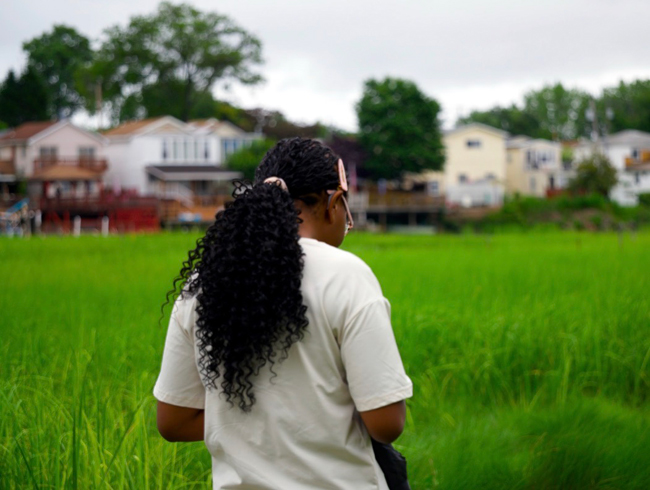
Rhianna visiting the salt marsh that the Natural Areas Conservancy planted at Soundview Park. Credit: Ivette Evangelista, 2026 NAC Intern
Rhianna Jackson is a Fall 2026 senior at Stony Brook University’s School of Marine and Atmospheric Sciences (SOMAS), where she majors in Environmental Design, Policy, and Planning. As a Wetlands Field Data Collection CEI Fellow, Rhianna worked on Natural and Nature Based Features monitoring along the Long Island Coast shorelines in the Bronx and Queens, assisting with field work and educational outreach in the Long Island Sound Watershed.
This summer, Rhianna worked closely with her mentor, Lillit Genovesi (NYSG, Outreach Coordinator, Long Island Sound Partnership, NYC and Westchester County), on doing outreach related to Long Island Sound. This involved assisting with educational programs held at City Island Oyster Reef, an environmental non-profit dedicated to restoring native oyster populations, as well as Sound Stewards programs with students in grades K-12 at various Long Island Sound Partnership Stewardship Sites in NYC.
“We would have groups of school-aged children come and teach them about the estuary,” Rhianna said of her experience as an educator. “While a lot of [the children] were aware that they lived near the Long Island Sound, they didn't know that it was [an] estuary and they didn't know a lot of the importance of the estuary.”
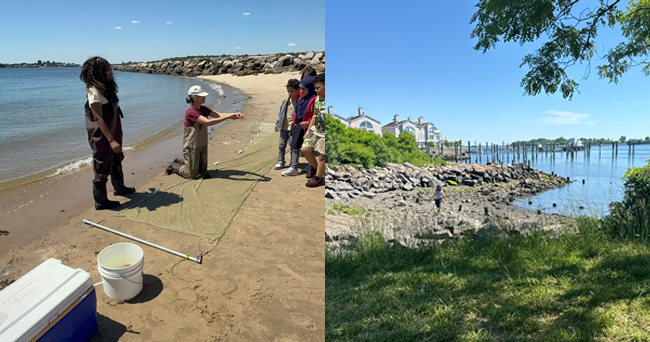
(L) Rhianna (left) and her mentor Lillit (right, kneeling) at Orchard Beach with children from the Bronx Children’s Museum. (R) City Island, where Rhianna did work with City Island Oyster Reef. Credit: Images courtesy of Rhianna Jackson
During outreach, she also worked with children at the Bronx Children's Museum, guided students during a visit to Orchard Beach, and used an EnviroScape watershed model to demonstrate how water moves from the highest point to the lowest point carrying stormwater and runoff.
“I also worked on a sewershed map, which is similar to what the EnviroScape is showing, and we did horseshoe crab monitoring really, really early in the morning. We didn't see any horseshoe crabs, but it was really fun.”
Later on, Rhianna worked with the Natural Areas Conservancy (NAC) on living shoreline analysis. Part of Jackson’s duties included interviewing stakeholders (such as NYS Parks, the New York Restoration Project, and Rocking the Boat) to determine whether a shoreline is successful in preventing erosion and other weather-related events, like flooding. She also worked on a case study for specific sites.
“We're collecting [historical] data on the use [of living shorelines] and data on the size. We want to put all that together to provide to people after we're done so that they can see more information about these sites and whether they were successful,” she said. “This has been one of my favorite parts of the summer — looking at actual sites and seeing how our work is actually applying to the things that we're seeing on paper.”
When asked what activities from this summer she’d like to still be doing in ten years, Rhianna didn’t think twice before answering.
“Ten years from now, I can see myself most likely working in a park site, helping them to restore the areas that are a bit more dilapidated than others,” she said. “I can see myself working in parks, helping them raise the money for [the work], and helping them maintain these areas that are becoming overgrown with invasive species.”
Matthew Johnson
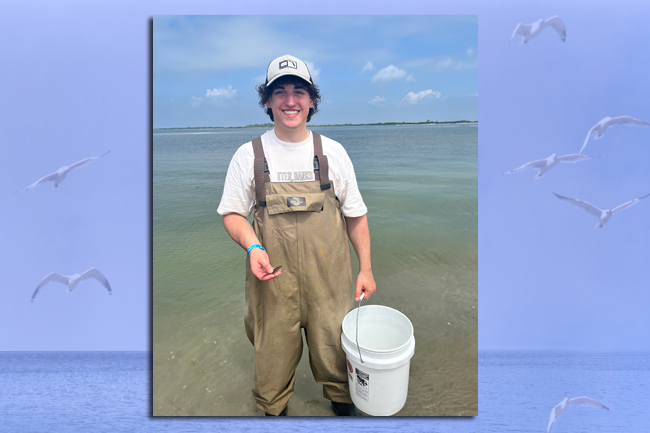
Matthew wearing a wader, carrying a bucket, and holding a marine critter while helping at Marine Field Trip at Jones Beach. Credit: Matthew Johnson
Matthew Johnson is a Fall 2026 senior at Stony Brook University’s School of Marine and Atmospheric Sciences (SOMAS), where he majors in Marine Science with minors in Environmental Studies and Political Science. As a 2026 Community Engaged Internship Fellow (CEI), Matthew was appointed Waterways Ambassador on the East End of Long Island. He assisted a Long Island community science group to monitor suspicious algae in freshwater systems while helping build a “HABs toolbox” for communicating hazards to the general public.
“Essentially, the project that I was working on was creating a media sheet for suspicious algae in freshwater as a way to communicate with stakeholders about what harmful algal blooms (HABs) are, their effects and causes, and how to report them if you think you see one,” Matthew explained.
To collect information for this project, Matthew assisted with field work for the Adopt-a-Pond program to collect samples from local freshwater sources, using equipment such as a YSI device to measure water quality parameters including dissolved oxygen and chlorophyll-A content. If the team suspected the presence of a harmful algal bloom, they sampled it and had it analyzed through the Gobler Lab (based on the Stony Brook Southampton campus); if the lab detected a toxic level, the information was forwarded to the DEC and reported so local communities could be aware and avoid using the affected waters.
“One of the main aspects of this internship was finding ways to interact with the community about harmful algal blooms,” Matthew explained, noting that HABs pose risks to both humans and animals, but response time can often be significantly delayed. “One of the ways that I helped (...) is by creating a GIS map to show which freshwater systems needed higher priority for reporting and general surveillance.”
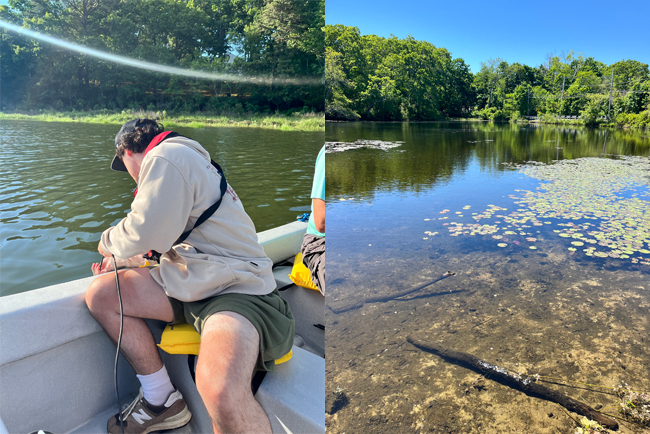
(L) Matthew leans over the side of a dinghy to send the YSI sonde tool over the side to collect water data at Mattituck Creek; (R) A view of East Pond in Southhampton, NY. Credit: Matthew Johnson
“Something that really stood out to me through this program was the field days, because it was very interesting seeing all the different freshwater systems that exist around Long Island, and how many different ponds and creeks there are in the area,” Matthew said. Matthew, who is from Georgia and previously believed that Long Island was predominantly focused on marine systems, notes that his training this summer helped him see things from a different perspective. “I hope to explore this area of research more as I progress through my undergraduate program.”
Matthew is very interested in estuarine ecosystems (coastal areas where freshwater mixes with salt water), and feels that his internship helped him gain more experience with the sort of work he hopes to do in the future.
“Hopefully, I can use these experiences to build on that interest [in estuaries],” he said.
In-between water sampling in the field, Matt assisted mentor Antoinette Clemetson (NYSG, Marine Fisheries Specialist) in teaching classes at the Marine Summer Field Trip Program at Jones Beach and worked on the media sheet as part of the HABs toolbox. Matthew even found time to appreciate his other coastal surroundings. When asked what a memorable part of the internship was, Matthew reflected on his favorite sampling location: Mattituck Creek.
“You don't even know how many ospreys are there — I'd say twenty at least. And it's not just them; there are also geese and ducks and cormorants and I think I've seen a great blue heron. It's just nice to be able to get that close to wildlife.”
More Info: New York Sea Grant
New York Sea Grant (NYSG) is a university-based, statewide Federal-State collaboration between the State University of New York (SUNY), Cornell University, and the National Oceanic and Atmospheric Administration (NOAA). It is one of 34 university-based programs that connects research, extension, and education with the needs of coastal communities, environments, and economies through NOAA.
Since 1971, NYSG has supported science-based solutions for a wide range of water-related challenges and opportunities across the state. Through NYSG’s efforts, university scientists and extension specialists help develop and transfer science and technical information to educational institutions, businesses, agencies, and industries; federal, state and local governments; the media; and the interested public. The program is administratively based at Stony Brook University (SBU) and Cornell's College of Agriculture and Life Sciences (CALS).
NYSG historically leverages on average a 5.5-fold return on each invested federal dollar, annually. The State benefits from this, as these resources are invested in Sea Grant staff and their work in communities right here in New York.
New York Sea Grant, one of the largest of the state Sea Grant programs, maintains Great Lakes offices at Cornell University, SUNY Buffalo, Rochester Institute of Technology, SUNY Oswego, the Wayne County Cooperative Extension office in Newark, and in Watertown. In the State's marine waters, NYSG has offices at Stony Brook University and with Cornell Cooperative Extension of Nassau County on Long Island, in Queens, at Brooklyn College, with Cornell Cooperative Extension in NYC, in Bronx, with Cornell Cooperative Extension of Ulster County in Kingston, and with Cornell Cooperative Extension of Westchester County in Elmsford.
Established in 1966, the National Oceanic and Atmospheric Administration (NOAA)’s National Sea Grant College Program promotes the informed stewardship of coastal resources in 34 joint federal/state university-based programs in every U.S. coastal state (marine and Great Lakes) and Puerto Rico. The Sea Grant model has also inspired similar projects in the Pacific region, Korea and Indonesia.
For updates on Sea Grant activities: www.nyseagrant.org, follow us on social media (Facebook, Twitter/X, Instagram, Bluesky, LinkedIn, and YouTube). NYSG offers a free e-list sign up via www.nyseagrant.org/nycoastlines for its flagship publication, NY Coastlines/Currents, which it publishes quarterly.