Contacts
New York Sea Grant Great Lakes:
Mary Austerman, Coastal Community Development Specialist, mp357@cornell.edu, 315-234-1160;
Roy Widrig, Coastal Processes and Hazards Specialist, rlw294@cornell.edu, 315-234-1916
New York Sea Grant Marine District:
Jessica A. Kuonen, Hudson Estuary Resilience Specialist, NYSG E: jak546@cornell.edu, P: (845) 340-3990 x323
Kathleen Fallon, NYSG Coastal Processes & Hazards Specialist, E: kmf228@cornell.edu, P: (631) 632-8730
New York, NY, May 6, 2026 — During National Hurricane Preparedness Week (May 3rd-9th), New York Sea Grant is issuing a seasonal reminder to residents in New York's Great Lakes and marine regions about information resources they can use to document flood impacts and to recover after a flood event.
1. MyCoast NY
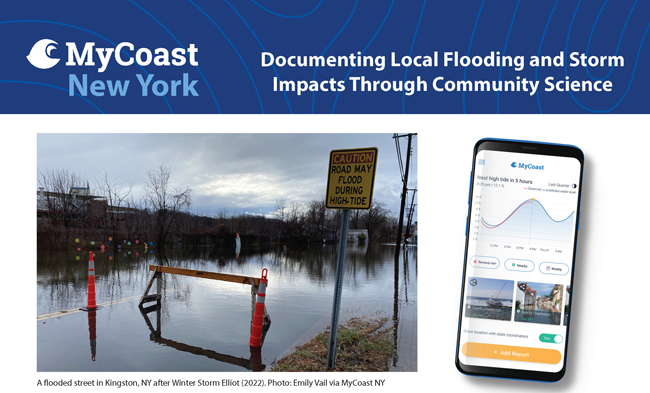
Anyone can download the MyCoast app or use the MyCoast website to upload and view photos of the impact of localized flooding and storm impact on property and in communities.
Photo tips:
• In some instances, it may be necessary to take multiple images to capture a majority of the waterline at your property. If possible, take a wide shot to include your home or business within the frame as a point of reference. Alternatively, include other landscape features such as roads or docks. If needed, you can upload more than one photo to capture multiple angles.
• Photos submitted to MyCoast are available for public domain use. Photos submitted through this statewide community science tool are used to create data sets and reports that help emergency management, state agencies, local planners, business owners, and residents make informed decisions for planning, response, and flood advisory communications; and to help leverage funding. Contributors to MyCoast NY should follow local safety precautions advised by local authorities and take photos only after a storm has passed and it is safe to do so.
MyCoast NY is a statewide tool funded by the New York State Water Resources Institute in partnership with the New York State Department of Environmental Conservation's Great Lakes Watershed Program and Hudson River Estuary Program with support from the New York State Environmental Protection Fund, Long Island Sound Study Partnership, and grant funding through New York Sea Grant and the FEMA Cooperating Technical Partners Program and the Sea Grant Debris Challenge Grant program. The National Sea Grant Office of the National Oceanic and Atmospheric Administration (NOAA) is providing additional support.
Related Resources:
Help document flooding and storm damage
• Fact Sheet: Flood Watch New York — Documenting Local Flooding and Storm Impacts Through Community Science (pdf)
• Flyer: Flood Watch New York — Volunteers Needed! (pdf) flyer
Help document local flooding and storm impacts through community science
• Fact Sheet: MyCoast NY — Documenting Local Flooding and Storm Impacts Through Community Science (pdf)
• Flyer: MyCoast NY: Volunteers Needed! (pdf)
2. After the Flood resources
New York Sea Grant provides assistance to landowners and communities to address coastal erosion impact.
Some of NYSG's related resource sites on these topics include:
• Great Lakes Coastal Processes — nyseagrant.org/glcoastal
• Marine Coastal Processes — nyseagrant.org/marinecoastal
• Dynamic Shorelines — nyseagrant.org/dynamicshorelines
• Long Island Sound Resilience Resource Hub — www.lisresilience.org
Related Resources:
• Fact Sheet: Long Island Sound Sustainable and Resilient Communities (pdf)
• Postcard: LI Sound SRC — Contacts (pdf)
• Resources: Climate Smart Communities Crosswalk
Other Resources:
• Guide: Argh! I Just Flooded! Now What? (New York State Department of Environmental Conservation)
• Fact Sheet: Flood Response and Substantial Damage in NYS (New York State Department of Environmental Conservation)
More Info: New York Sea Grant
New York Sea Grant (NYSG) is a university-based, statewide Federal-State collaboration between the State University of New York (SUNY), Cornell University, and the National Oceanic and Atmospheric Administration (NOAA). It is one of 34 university-based programs that connects research, extension, and education with the needs of coastal communities, environments, and economies through NOAA.
Since 1971, NYSG has supported science-based solutions for a wide range of water-related challenges and opportunities across the state. Through NYSG’s efforts, university scientists and extension specialists help develop and transfer science and technical information to educational institutions, businesses, agencies, and industries; federal, state and local governments; the media; and the interested public. The program is administratively based at Stony Brook University (SBU) and Cornell's College of Agriculture and Life Sciences (CALS).
NYSG historically leverages on average a 5.5-fold return on each invested federal dollar, annually. The State benefits from this, as these resources are invested in Sea Grant staff and their work in communities right here in New York.
New York Sea Grant, one of the largest of the state Sea Grant programs, maintains Great Lakes offices at Cornell University, SUNY Buffalo, Rochester Institute of Technology, SUNY Oswego, the Wayne County Cooperative Extension office in Newark, and in Watertown. In the State's marine waters, NYSG has offices at Stony Brook University and with Cornell Cooperative Extension of Nassau County on Long Island, in Queens, at Brooklyn College, with Cornell Cooperative Extension in NYC, in Bronx, with Cornell Cooperative Extension of Ulster County in Kingston, and with Cornell Cooperative Extension of Westchester County in Elmsford.
Established in 1966, the National Oceanic and Atmospheric Administration (NOAA)’s National Sea Grant College Program promotes the informed stewardship of coastal resources in 34 joint federal/state university-based programs in every U.S. coastal state (marine and Great Lakes) and Puerto Rico. The Sea Grant model has also inspired similar projects in the Pacific region, Korea and Indonesia.
For updates on Sea Grant activities: www.nyseagrant.org, follow us on social media (Facebook, Twitter/X, Instagram, Bluesky, LinkedIn, and YouTube). NYSG offers a free e-list sign up via www.nyseagrant.org/nycoastlines for its flagship publication, NY Coastlines/Currents, which it publishes quarterly.