Navigate to ... Sea Grant News | Publications/Media | Related Resources | On YouTube, In Photos
Heading to the beach this summer? NOAA and Sea Grant are urging beachgoers to learn how to “Break the Grip” of rip currents before getting into the water. Rip currents are a potentially deadly threat -- accounting for more than 80 percent of lifeguard beach rescues.
Rip currents are narrow channels of fast-moving water that pull swimmers away from the shore. They can occur at any of New York’s many beaches with breaking waves--from the ocean beaches of Coney Island or Jones Beach to the eastern shore of Lake Ontario.
Moving at speeds of up to eight feet per second, rip currents can move faster than an Olympic swimmer and can easily overpower a victim. Panicked swimmers often fail trying to counter the current by swimming straight back to shore — putting themselves at risk of drowning because of fatigue.
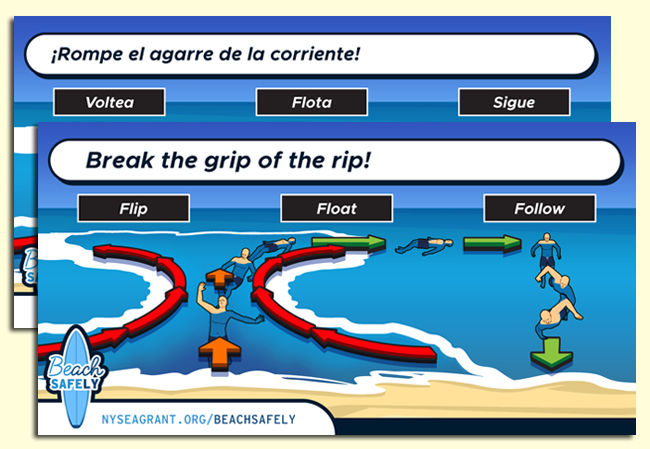
If caught in a rip current, don’t fight it! Swim parallel to the shore and then swim at an angle – away from the current – toward shore. New York Sea Grant coastal specialist Kathleen Fallon advises, “The best thing to do is to swim only where lifeguards are on duty unless you are experienced with identifying rip currents and know how to avoid them.”
“Education is critical, especially for those who visit the beach infrequently and may be unfamiliar with this leading surf hazard,” says Timothy Schott, meteorologist with the National Weather Service Marine and Coastal Branch. “As part of the NOAA Rip Current Awareness campaign, we have developed bilingual English-Spanish signs to reach a wider audience with life-saving instructions on how to break the grip.”
"Rip currents can be killers. The United States Lifesaving Association estimates that the annual number of deaths due to rip currents on our nation's beaches exceeds 100,” says Peter Davis, president of the Gulf Coast Region of the United States Lifesaving Association and chief of the Galveston Island Beach Patrol.
NOAA offers the following safety tips:
- Swim at lifeguard-protected beaches.
- Never swim alone.
- Speak to on-duty lifeguards about rip currents and other expected water hazards.
- Many coastal National Weather Service offices issue Surf Zone Forecasts providing a three-tiered structure of low, moderate and high to describe the rip current risk. All National Weather Service offices forecasting a moderate to high risk of rip currents include this information their Hazardous Weather Outlook. These forecast products are available online at www.weather.gov.
More safety tips and educational materials can be downloaded at www.ripcurrents.noaa.gov.
SEA GRANT NEWS: 2008-PRESENT back to top
Survey: Beach Safety Game (May 2021)
You're invited to participate in a survey and game to help us learn about people’s understanding of beach hazards.
As part of a joint-research project between New York Sea Grant and Hofstra University, you'll be asked a series of questions, play a computer game, and then be asked a second set of questions; this should take no longer than 20 minutes.
Survey: Creating A Network of Professionals Working in Rip Current Research, Education, and Safety / Awareness along Long Island's Atlantic Coastline (August 2020)
New York Sea Grant, in partnership with the Mid-Atlantic Regional Association Coastal Ocean Observing System (MARACOOS) developed a survey to gauge the level of interest in participating in a network of professionals who work in the fields of rip current research, education, and safety / awareness along Long Island's Atlantic Coastline - including all ocean beaches from New York City to Montauk.
This survey is a first-step in forming this network, which would include but is not limited to: academics, forecasters, lifeguards, and emergency managers. The goal is to learn more about the work you do, and to assess your current needs and interests in furthering rip current awareness to increase beach safety.
If you have any questions or concerns, please contact Kathleen Fallon, NYSG's Coastal Hazards Specialist, at 631-632-8730 or by email at kmf228@cornell.edu.
#BEachSAFEly: COVID-19 Rapid Response (Summer 2020—2021)
In Summer 2020, COVID-19 brought more considerations beyond the usual beach safety messaging. So, our Sea Grant programs in New York and New Jersey launched a weekly social media campaign to remind beachgoers to stay safe and have fun.
The summer-long campaign — a partnership between New York Sea Grant and the New Jersey Sea Grant Consortium that began with a COVID-19 Rapid Response grant from the National Oceanic and Atmospheric Administration’s National Sea Grant College Program — returned in Summer 2021, with modifications as COVID-19 restrictions were revised.
More News
For additional news on this topic through the years, see NYSG's up-to-date #ripcurrents archives
PUBLICATIONS AND RELATED MEDIA: 2008-PRESENT back to top
Publications
Coastal Processes on Long Island - Rip Currents (pdf) (June 2018 - 2019)
Sea Grant & Rip Currents Awareness: Mid-Atlantic Regional Highlights (pdf) (July 2012)
Understanding Waves & Currents (pdf) (July 2012)
Rip Tide, Rip Current, Undertow: Knowing the Difference Could Save Your Life (pdf) [1.2 MB file] (July 2011)
Beach Hazards - What is Your Greatest Fear? (pdf) [1.3 MB file] (June 2010)
Media
Newsday: As season opens, LI beaches ready (May 28, 2011)
Newsday: After drownings, lifeguards caution swimmers about ocean's dangers (May 27, 2010)
Newsday: Many South Shore ocean swimmers rescued from rip current (July 31, 2011)
NY Times: The Appeal and Danger of the Beach in the Dark (Aug 19, 2009)
NY Daily News: Rockaways' currents can be deadly if not treated with caution (Aug 19, 2009)
Newsday: Many South Shore ocean swimmers rescued from rip current (July 29, 2008)
OTHER NOAA AND SEA GRANT-RELATED RESOURCES back to top
NOAA's National Weather Service Rip Currents Web Site
Features include: A rip current overview; Links to real life rip current stories, media and educational tools including multimedia, beach safety tips, local weather and surf forecasts, cool photos, games and a glossary. Also available on the site are links to download full color brochures and signs in English and Spanish on rip current safety.
And new for 2011, a kids page, medical concerns, and 28 widgets offering lifesaving messages and safety tips. Look for the "Whistle For Life" with the Break The Grip of The Rip graphic. They'll be distributed by local coastal weather forecast offices and by lifeguards.
NOAA Ocean Service: Education - Coastal Currents
National Weather Service: Rip Current Safety - Photos
ON YOUTUBE, IN PHOTOS: SEA GRANT'S RIP CURRENTS EDUCATION back to top
Videos featured above include: "The Grip of Rip Currents" (YouTube link), "Rip Currents in the Great Lakes" (YouTube link) and "What is a rip current?" (YouTube link)
International spotlight: What are rip currents and how can you survive them (December 2008)
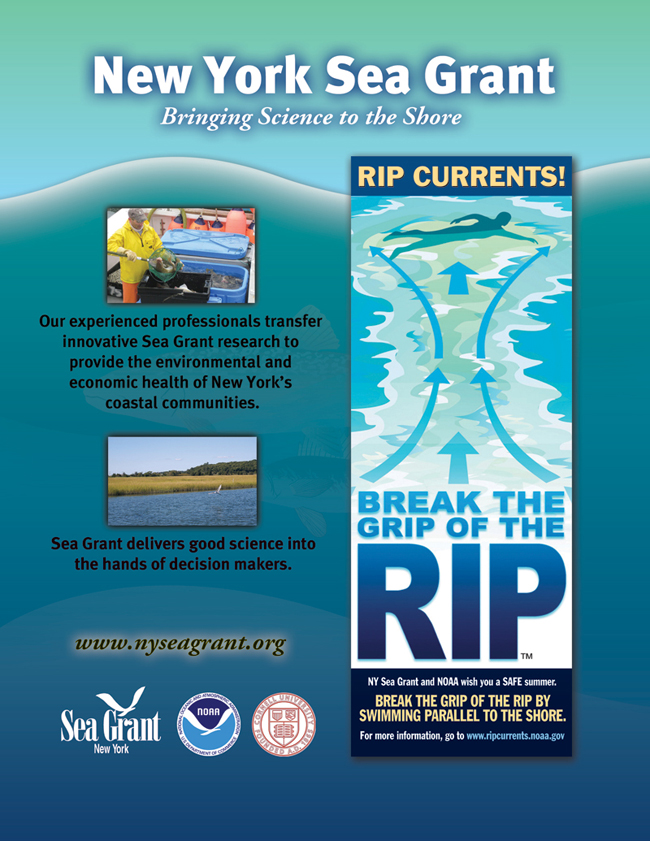
Heading to the beach this summer? When going in for a swim, be alert to the signs of rip currents. The National Oceanic and Atmospheric Administration (NOAA) and the National Sea Grant College Program remind you not to get dragged out to sea.
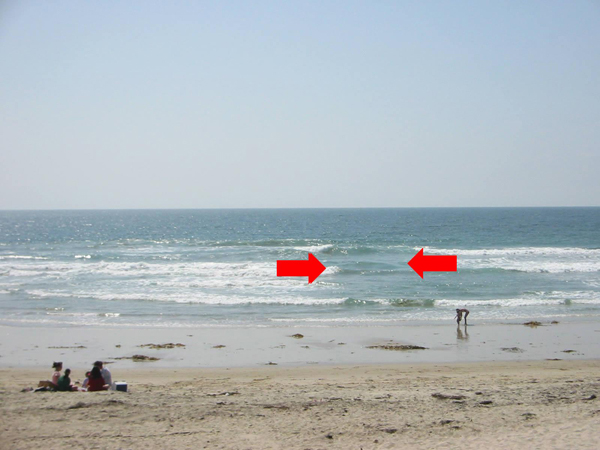
Pictured between the red arrows is a rip current, as seen from the beachgoer's perspective.
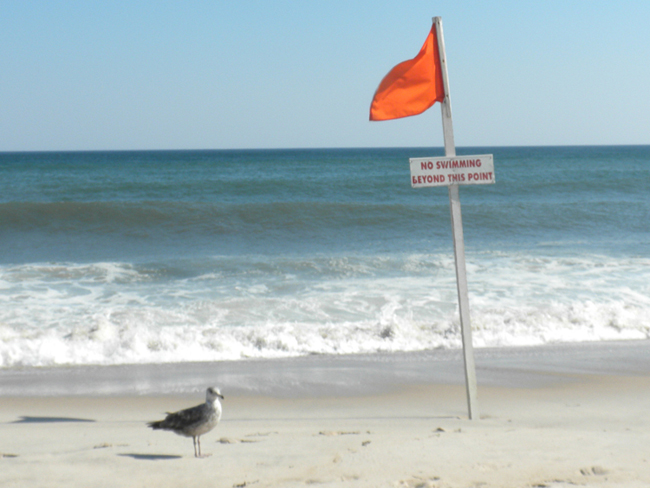
Beach warning flags come in a variety of colors, some of which are blank while others have symbols. The red, yellow, orange and green flags are warnings about the currents or surf. One or two red flags or a black flag means "high surf and no swimming," while green means "calm waters." Yellow signs report light surf or currents and advise caution.
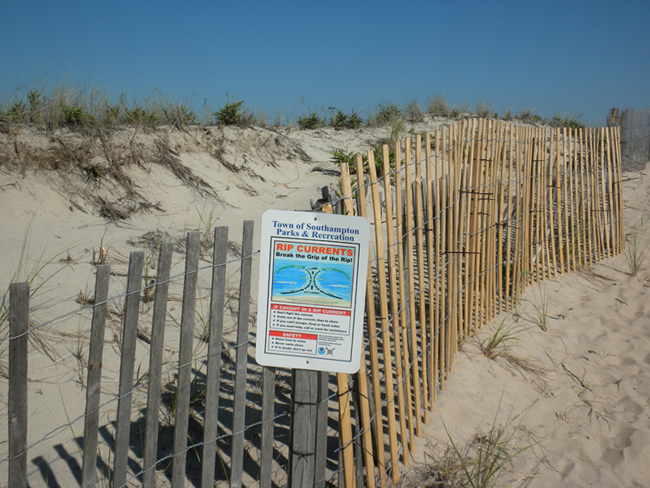
Signs like this one at Ponquogue Beach in Hampton Bays, NY educate beach goers how to break the grip of a rip current if caught in one while swimming.
